Let’s Talk Cooking Oils
What we were told, what we discovered, and what we had to unlearn
Rhoda Falaye
My Starting Point Canola Oil and Convenience
There was a time in my life when canola oil was a staple in my kitchen. As a college student, I was thinking about affordability, convenience, and what everyone else was using not processing methods or long term effects.
At the same time, I had heard all sorts of things about palm oil the one we used back home.
That it was bad.
That it was too fatty.
That it should be avoided.
Looking back now, I realize: A lot of what we were told was not the full story.
What Are Vegetable Oils Really
Most people hear vegetable oil and assume it comes from vegetables. It. Does. NOT. And many of them are heavily processed to become shelf stable and neutral in taste.
What Changed for Us
When we started paying attention to ingredients and how our bodies responded to food, we made a shift. We moved away from canola and generic vegetable oils. Our first step was olive oil. Then avocado oil. And I remember telling my husband almost 9 years ago:
“We will either spend the money on healthy food, or we will spend it in the hospital.”
Sometimes, we have to choose our hard.
Olive Oil Has Its Place
Olive oil is one of the best oils when it is real. Best used for: Drizzling, Dressings, Light cooking
But not my first choice for high heat cooking.
Avocado Oil for High Heat
Avocado oil became our go to for: Frying, Roasting, Higher heat cooking.
It is more stable and neutral in taste.
Then Came the Hardest Shift Tallow
This one took time. My older Sister introduced this to us many years ago. I had to unlearn everything I thought I knew about animal fat. Then last year, I made tallow myself and that changed everything.
What Is Tallow
Tallow is rendered beef fat. It is: slowly heated, strained, left as a clean, stable cooking fat. No chemicals.
No additives. Just one ingredient.
How Tallow Works in the Body
Tallow contains fats that are structurally similar to those used in the human body. That matters.
It: provides steady energy, supports satiety, is stable under heat. And beyond cooking, I have even used it for skin care for my family.
Let’s Talk Butter
Real butter. Not spreads. Not substitutes.
About 3 to 4 years ago, I started making our own butter and it is easier than most people think. It can also be frozen for months.
Can You Cook with Butter?
Yes you can sauté with real butter. Butter works best for:
Low to medium heat cooking
Eggs
Vegetables
Finishing meals
But butter contains milk solids, and those milk solids can burn at higher temperatures. So for high heat cooking, butter alone is not always the best option.
Simple Kitchen Wisdom
If you want flavor and stability:
Use butter with avocado oil or tallow
Or switch to ghee
What About Ghee
Ghee is clarified butter. It has:
Higher heat tolerance
No milk solids
A rich and nourishing profile
It gives you the flavor of butter with better performance for cooking.
Other Oils We Use
Coconut Oil
Stable
Single ingredient
Distinct taste
Peanut Oil
Gets the job done but I only bought once!
Quality matters
Not my top choice but do your research!
We Still Use Palm Oil
But not just any kind. We use the one from home minimally processed and true to its source. Because not all oils are the same!
Palm oil is one of the most misunderstood oils. For many of us, it is what we grew up using. It was normal. It was part of how we cooked. But somewhere along the way, it was labeled as something bad to avoid. The truth is: Not all palm oil is the same. Palm oil comes from the fruit of the palm tree. The one we use from home is: minimally processed, rich in color (not coloring), and true to its source
That is very different from many of the palm oils people see today that are: refined, highly processed, and mixed from different sources.
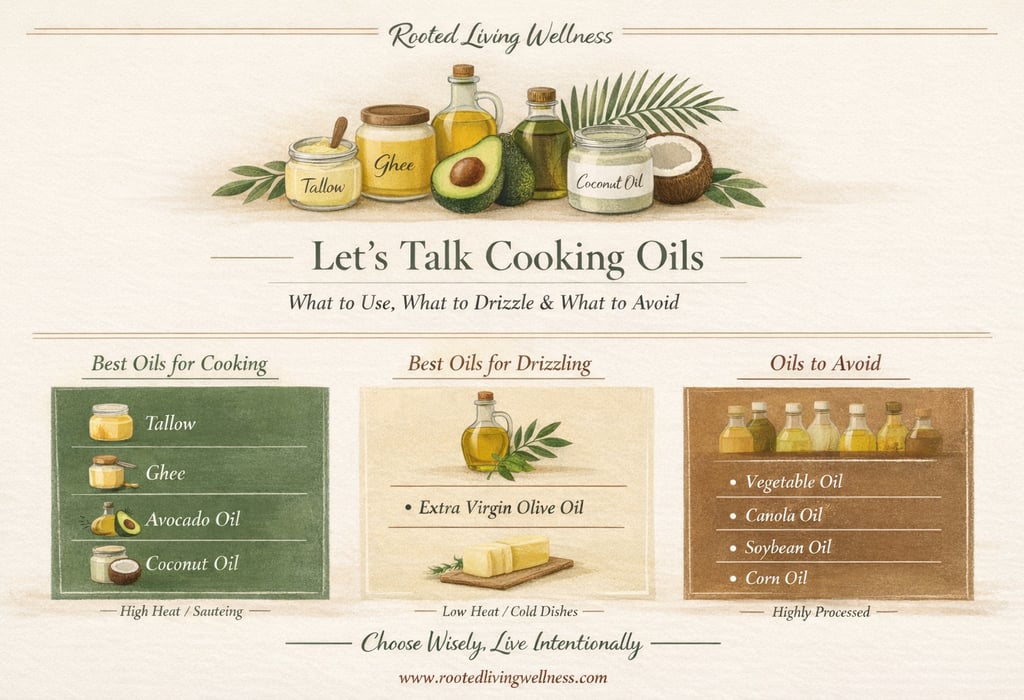
So What Oils Are Best for Cooking?
For higher heat: Tallow, Ghee, Avocado oil, Coconut oil, Palm oil.
For low to medium heat cooking: Butter
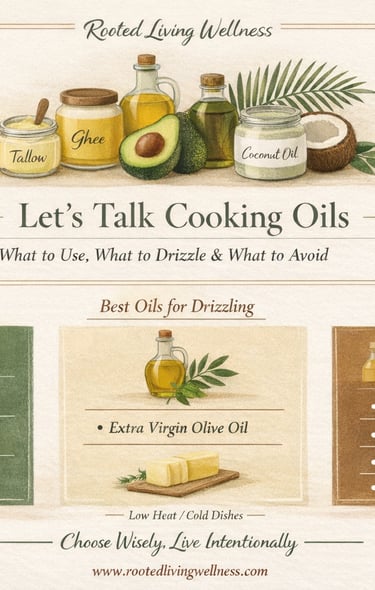
Best Oils for Drizzling: Olive oil
Why the Concern
Not fear but awareness. The concern is: heavy processing, repeated high heat use, & overconsumption through packaged foods.
We Have to Retrain Our Taste Buds
Some of these oils will taste different. That is okay. Many of us have been conditioned by additives and processed flavors. So part of this journey is: Unlearning and Relearning!
A Simple Rule We Live By: Every oil in our kitchen has...
one ingredient.
And we always check:
Where it comes from
How it was processed
Final Thought
This was not overnight.
It was a process.
But one thing is clear:
The oils we cook with are daily decisions.
And daily decisions shape our health.